
Getting Started On Bass. The Beginner’s Guide To Learning Bass
Whether you’re coming to the bass as a guitar player, picking up the low-end duties for a band in need, or have yet to play your first note – this is the place to start. We’re firm believers that the bass is the best instrument to pick up (with a small amount of bias involved), and can be a valuable lifelong asset for aspiring career musicians and for hobbyists wanting to explore music in a new way.
While there’s plenty of material out there for new bass players to dig into, it’s all too easy to head down the wrong path and get stuck. Even before you’re at a stage to start learning, decisions about your gear will have a huge impact on how smooth those early steps will be. Take it step-by-step and follow this guide to set yourself up for success in the long-run!
As a final note; patience is a true virtue when learning any new skill, particularly an instrument. It’s an entirely new language to learn, so be kind to yourself along your journey and keep sight of your progress.
Finding & Buying Your First Bass
While it might seem simple to search ‘beginner bass guitar’ in Google, click on a bundle that comes with an amp, guitar strap, and tuner, and tick this one off – please hold fire before clicking buy!
A quality instrument makes an untold amount of difference in a beginner’s ability to get comfortable with and start learning. A bass that’s easy to play, sounds good, and responds well to input will be less strenuous for your hands and fingers as you build strength and stamina, and will be more inspiring and enjoyable to pick up and play. You’ll advance at a much quicker pace if you don’t feel like you’re fighting it to make some noise.
What Beginner Basses To Choose?
Fortunately, a quality bass guitar doesn’t have to cost the earth in 2026. Several brands offer affordable basses that will be an ideal choice for a new bassist. Top brands include:
Squier – Several key product lines to note in order of expense: the Sonic series, Affinity series, and Classic Vibe series
Yamaha – Several TRBX basses and the popular BB234/BB434 models are great picks
Ibanez – SR and GSR models offer good value, as well as the Talman TMB series of basses.
Sire – Incredible value from a relatively new brand. V1, V3, and V5/P5 models are all good choices.
Your pick will depend on your available budget, but a bass from any of the brands mentioned here will serve you well. Don’t be afraid to go with a bass that you think looks cool too – aesthetics matter! The more you like your bass, the more you’ll reach for it to play.
BassBros Tip: Set aside some money to have your new bass set up by a professional technician or luthier. Costs can be as little as £40 for a standard setup and it will greatly improve playability as a result. We set up every single bass guitar we receive at BassBros before it finds a new home, no matter how expensive, because we know how big a difference it will make.
Differences Between Types Of Basses
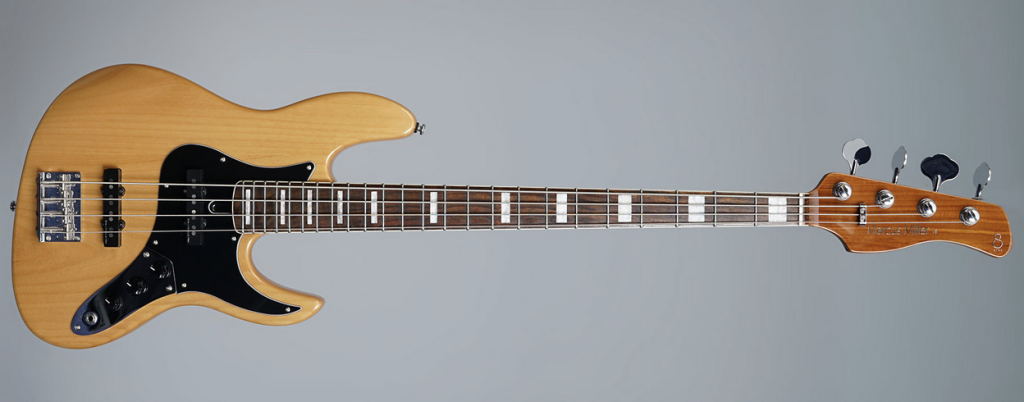
Not all basses are created equally. In fact, no two basses are really ever the same! It can seem pretty daunting to explore the various shapes, sizes, and designs of basses available, but there are really only a few factors that will fundamentally change how you use the bass itself.
- Number of strings – basses can range from four to six strings (and more in extreme cases), but the vast majority will be four or five strings. We recommend beginners learn on a four-string bass in the vast majority of scenarios.
- Scale length – basses are built to one of three scale lengths – 34” (long scale), 32” (medium scale), and 30” (short scale). We recommend a long scale bass for most beginners, but a short scale bass is perfect for younger or players with smaller hands.
- Pickup type and controls – basses come equipped with a wide range of pickup configurations, but they’ll all work to make noise! The main factor to consider is whether the bass is passive or active, and how the controls work. Passive basses, such as a precision bass, are simple to use, have limited controls, and don’t require a battery to use, making them great picks.
Other Gear Needed To Learn Bass
We’re almost ready to start making some noise! There are a few pieces of gear that will help make becoming a bass legend that bit easier and we highly recommend picking up:
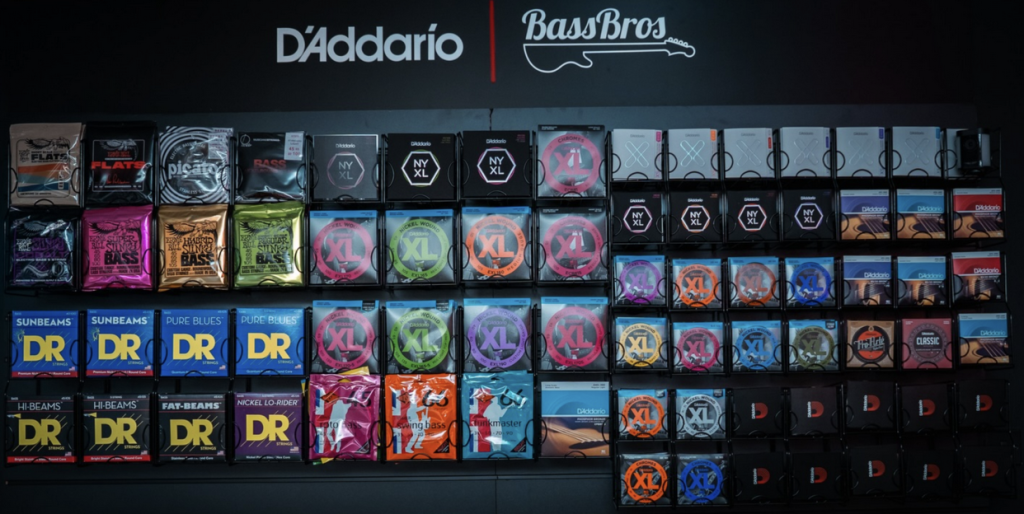
- Bass Amplifier – while it’s possible to play a bass without an amp, you’ll struggle to hear yourself well and it will be much tougher to learn good technique. A cheap bass amp will work wonders and can be had at affordable prices.
- Tuner – A cheap clip-on tuner from a brand such as Snark will let you tune each bass string with accuracy. If your bass isn’t in tune while you play, even the right notes will sound wrong – we don’t want that!
A few honourable mentions of gear that’s by no means essential but can be helpful:
- Bass guitar strap – Not a super exciting buy, admittedly. A bass guitar strap is handy to keep the bass stable while you’re playing sitting down and is mandatory if you want to stand up while playing.
- Bass guitar stand – If you want to keep your bass guitar secure when not being played a stand is the way to go. You can always go for the tried-and-tested lean upright in a corner approach, but a bass guitar stand is a good way to avoid any accidents!
- Bass guitar case/gig bag – Super handy if you’re transporting your bass anywhere, such as to a bass guitar lesson. Some basses will come with a gig bag or case as standard, so it’s worth checking before making a purchase.
Setting Yourself Up For Success
You’ve got the gear, everything is unpacked, and you’re ready to rock. We’ve got a few tips below that, while not necessities, can help you get the most out of your practice sessions and help build your confidence as you get used to the instrument.
Create A Comfortable Environment & Have The Bass Easy To Access
Try and create a space where you can make a (reasonable) bit of noise without disturbing others and can keep the bass out and ready to play. It’s so much easier to keep a good practice routine when you simply need to sit down and switch on your bass amp to start playing, and you’ll find yourself playing much more frequently if you have the space to do this.
A comfortable chair and a small amount of space is all you need to create a cosy bass corner!
Tune Your Bass Before You Play
Get into the habit of tuning before you practice or play. The clip-on tuners that attach to your bass guitar headstock are ideal as you can simply switch it on, tune up, and start playing. Many players opt for a dedicated tuner pedal as their method of choice. Either works!
Get Used To The Building Blocks Of Playing Bass
Every bassist develops their own style and feel as they grow, and your journey will be no different. Even as you establish your personal approach to playing you’ll want to keep these core building blocks in place. They’ll help you play more efficiently, reduce any strain, and set you up for long-term success.
How To Hold A Bass In Playing Position Correctly
Holding a bass correctly has a massive impact on your comfort level and the ease of playing the instrument, especially over a long session or multiple sessions throughout a week. Getting the ergonomics right early will pay off over your entire bass journey and reduce strain and risk of injury.
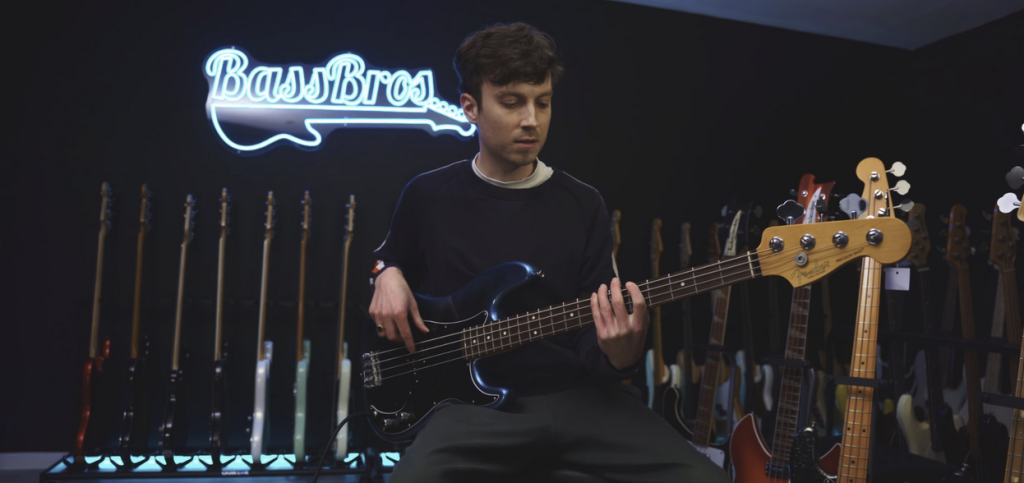
The image below shows how a bass should sit comfortably in the playing position. Pay close attention to how your fretting arm feels when in place to fret a note. Most points of discomfort come from having the wrist and hand too bent or in an awkward position, and will reduce your mobility and stamina if not corrected.
Key points:
- The wrist should be largely in line with your forearm, with a small bend to allow for upper string access
- You will naturally adjust how much bend is in your wrist relative to where you’re playing on the fretboard
- The neck should point away from the body at a gentle angle and shouldn’t be parallel to your body
- Pointing the neck away at a small angle helps both your plucking hand to access the strings and the fretting hand to access the lower register
- The neck should not ‘dive’ or fall down and should point slightly upwards
- Most basses will naturally rest correctly when a guitar strap is used, though basses with light bodies and heavy necks will dip without any compensation
How To Fret Notes On The Bass
This part will trip beginners up the most. Proper fretting techniques require a combination of strength, dexterity, and technique to ensure notes play cleanly and without issues. We need to use our fretting hand to press down on specific frets and strings in order to play the required notes, and apply the right amount of pressure to allow the note to play cleanly and without any buzz.
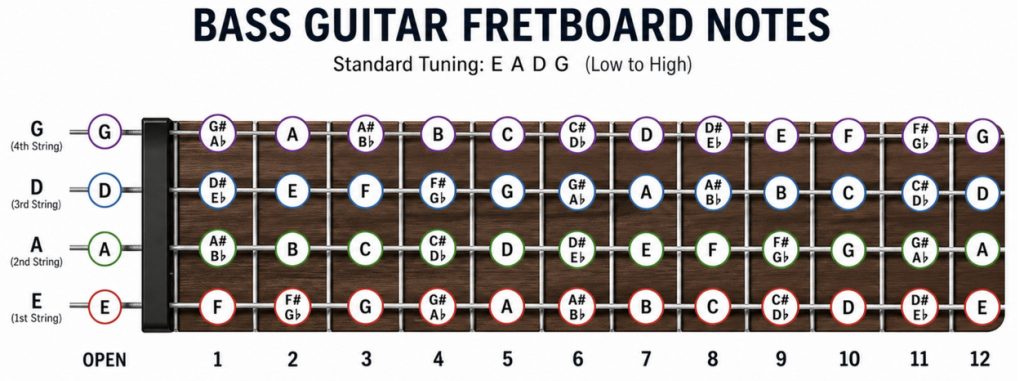
Many players will use the ‘finger-pre-fret’ rule, which assigns each of your four available fingers to a specific fret. For example, if your index finger frets an A note (5th fret on the E string), you would assign your middle finger to fret 6, ring finger to fret 7, and little finger to fret 8. This allows you to play a range of notes within that box without having to move a great deal. Others prefer the Simandl technique, which uses a similar approach but reduces to a 3-fret box for less stretching of your hands.
The diagram below shows the fretboard and how the notes relate to each fret and string.
Key concepts to think about when fretting a note:
- Check you are targeting the correct string and fret
- Use which finger feels most comfortable to fret the note
- Typically start with your index finger until you feel confident
- Use the tip of your finger to press down on the string
- Avoid pushing or pulling the string across the fretboard, try and press directly ‘into’ the fretboard to ensure the note is pitched correctly
- Pluck the string with your plucking hand and listen for the clarity of the note
- Do you hear buzzing? How long is the note ‘lasting’ (sustaining) for?
- Lift your finger off and repeat the process until you can play clear notes consistently
How To Pluck Bass Strings Correctly
There are several methods of playing the strings themselves with the most common approaches using the index and middle fingers to play the strings (known as fingerstyle) or using a plectrum. This is the final piece of the puzzle to get you off the ground!
Plucking bass strings cleanly is mostly about control, consistency, and relaxation. Here’s a breakdown of the standard fingerstyle technique used by most bass players:
Basic Right-Hand Position (for right-handed players)
Rest your thumb on either the pickup, the lowest string you’re not playing, or a thumb rest if your bass has one. This provides an anchor point for an alternating fingerstyle technique to work from. Your index and middle fingers should hover above the target string and you’ll want to shift your anchor point as you change strings.
Your wrist should stay fairly neutral and in a comfortable position – avoid bending too much at the wrist. Basses with a contoured body will make this feel more natural.
The motion
Instead of “pulling upward,” think of moving through the string or toward the next string. Your fingertip should lightly contact the string, then follow through as if you’re attempting to touch the next string.
Example:
- If you pluck the A string, your finger moves in the direction of and may come to rest on the E string afterward.
This is called rest stroke technique and helps produce a fuller and more consistent tone.
A few additional pointers:
- Use the soft part of the fingertip, not your fingernail
- Try and use small efficient movements with each finger and let the amp do the work
- This is general technique advice! Some genres and styles of playing want that heavy attack – see Geddy Lee in action for proof!
- Play around with your contact point. Playing closer to the bridge creates a punchier and brighter note, while playing towards the neck adds warmth and roundness to notes
Avoid:
- digging in with your fingernail
- hooking underneath the string and pulling it
How & Where To Learn Bass
There are countless paths to building your technique and knowledge, so much so that it can be incredibly daunting to find the right help.
Find A Quality Bass Guitar Teacher
The most straightforward and reliable approach is to find and learn with the guidance and support of a bass guitar teacher. A good teacher is an invaluable asset and you’ll progress at the quickest pace this way.
Check reviews and have a talk with them about your goals and current ability to gauge if they’re the right fit. It’s important you have a good rapport with your teacher to get the most out of the sessions, and be prepared to dedicate as much practice time outside of lessons as possible to get the best results.
Explore The Online Bass Tuition Services Available
Online bass tuition courses have become a really popular choice for a number of reasons. They’re easy to access and use, and there is no time limit on the session itself, allowing you to learn at your own pace.
Many online courses, such as Scotts Bass Lessons or BassBuzz, have tons of free resources and lessons available via their YouTube platforms, so it’s worth checking a few out to see if they could work for you.
Leverage YouTube To Learn Specific Techniques Or Songs
As mentioned a moment ago, YouTube is a treasure trove for exploring specific techniques or a certain bassist’s approach to playing in great detail. The trick to getting the most out of YouTube is to know what you’re looking to learn, which can be tricky if you have no grounding in the instrument.
Learn To Read Tablature & Explore Tabs
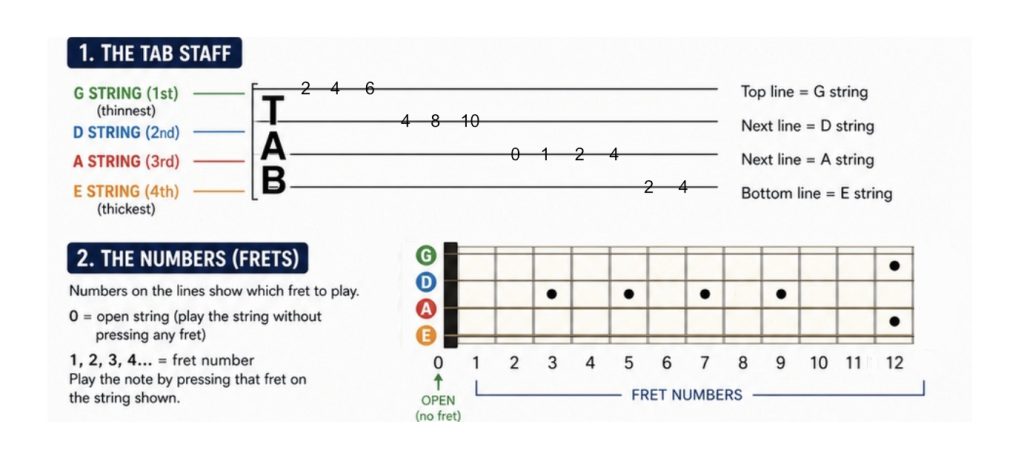
Tabs are a common method of writing out how to play a song or bassline and can be found on tab sites online. Learning to read tabs will help you find new music to learn as you progress without needing to build your music theory and traditional notation reading skills.
Check out the diagram below for the basics of reading tab, though it’s important to use your ear and listen to the song or bassline you’re trying to learn when reading tab as it doesn’t always represent the rhythm or timing of the notes to any great detail.
The Next Steps In Your Bass Journey
You’ve got your gear, set up the building blocks of your ability, and gotten comfortable with the bass itself. It’s at this stage you can start to branch out and advance to the next stage in your learning journey.
Master Your First Songs
There’s no better feeling than cracking that first song and nailing it from start to finish. And once you’ve mastered one, you’ll quickly start looking for more to learn. We think it’s always good to have a few songs
Create a playlist in your music player of choice for songs that inspire you. These will serve as long-term goals you can keep sight of as your skills progress, and will drive you to pick up the bass consistently and progress.
Combining tabs and YouTube to learn specific songs will do the job most of the time, but don’t hesitate to speak to your music tutor (if you’re working with one) and they’ll also be able to help. If you aren’t quite at the skill level to learn a specific song just yet, be patient and return to it at a later date.
Dive Into The World Of Music Theory
Music theory is an absolutely invaluable tool for a musician looking to take their capabilities further. While it is a huge accomplishment to build the technical abilities needed to play the bass itself, developing the theoretical knowledge to understand what and why you are playing specific notes or phrases in context to a song is a whole different beast.
Music theory is a vastly complex subject – it quite literally is a whole new language to learn – and people will devote their lives to growing and mastering every facet of music theory possible. Fortunately, it doesn’t take a PhD to grow a solid amount of music theory knowledge that will help you play with greater confidence and freedom.
Key areas of theory to explore:
- Learn the notes and their positions across the entire bass fretboard
- Learn the major and minor scales
- Understand both the scales themselves, the scales relative to each note, and the shapes of the scales across the bass guitar fretboard
- Learn about time signatures, tempo, rhythm and how notes are measured within a song
- Notes will have a specific length relative to the number of beats in a bar
- Quarter notes last for 1 beat (a quarter of a 4-beat bar)
- Half notes last for 2 beats (half a 4-beat bar)
- This will change relative to the time signature you play in, though the majority of popular music is played in 4/4 timing (4 beats per bar)
- Notes will have a specific length relative to the number of beats in a bar
- Learn about chord tones and what notes build each chord, as we can use these notes to build and improvise basslines within that chords framework
- Major chords (1st, 3rd, and 5th notes in a scale)
- Minor chords (1st, flat 3rd, 5th notes in a scale)
- Major 7th chords (1st, 3rd, 5th, 7th notes in a scale)
- Minor 7th chords (1st, flat 3rd, 5th, flat 7th notes in a scale)
- Dominant chords (1st, 3rd, 5th, flat 7th notes in a scale)
This is a small but important selection of concepts to explore as part of your music theory learning. As your knowledge grows, your understanding of the reasoning behind note choices will improve and you’ll be able to improvise your own basslines that stay musically relevant to the song while adding your own unique flair. It’s a brilliant and liberating feeling, so it’s worth the time and effort to build your theory knowledge!
Listen To The Greats & Find What Appeals To You As A Bassist
Even when you’re away from the bass guitar itself, the work doesn’t stop! Passive listening can be a powerful tool in developing your bass sensibilities, your ear for basslines and notes, and your understanding of rhythm and melody.
Whenever you’re listening to music try and focus on what the bass is doing. Is it playing simple pulsing notes in time with the kick drum? Is it playing a unique etude that contrasts with other instruments? Is it mixed at the front of the song or further back in a supportive role?
There are countless questions you can think about without picking up the bass at all. Don’t be afraid to note down your thoughts to review later, try and pick out specific notes being played, and then take those thoughts home and try to replicate it on your bass. This will help train your ear’s ability to hear notes and your relationship with the music.
Keep The Passion!
As fun as it is to learn and play any instrument, we all will hit roadblocks or patches where the inspiration isn’t quite there. While it might seem best to try and brute force your way through, we always feel that it’s important to focus on what is bringing you enjoyment and energy most.
If the minor scale exercises are starting to grind you down, flip the script and play some songs you know and love – even if you’ve already mastered them. Sometimes it’s good to just play and not worry about directly climbing the ladder!
Frequently Asked Questions About Learning Bass
Why Should I Learn Bass Guitar?
Everyone will have a different reason to learn any instrument, and bass is no different. The most common reasons to learn bass guitar include:
- You like a genre of music, a band, or artist that heavily features the bass in your favourite songs.
- This is one of the best drives for any budding musician. Learning and playing the songs of your favourite bands is one of the best feelings out there!
- You have the opportunity to play in or join a band and they’re on the hunt for a bassist.
- Ensure any bands you join understand your skill level ahead of time. If you’re all learning and growing together it can be an amazingly supportive environment to grow as a musician!
- You have a passion for music and want to explore it as an active participant as well as a listener.
- You play other instruments, such as guitar, and think that bass could be helpful.
- Musicians writing and creating music benefit greatly from having a fundamental knowledge in bass guitar, for both writing and recording purposes.
- You feel that music could be an enjoyable career path.
- You enjoy learning new skills and think bass could be interesting.
Is It Harder To Learn Bass Or Guitar?
Bass is a tricky subject when challenge is involved, and an interesting one when compared to guitar. It’s probably most accurate to say that it’s easy to pick up and learn, and incredibly hard to master, while guitar can take longer to build a fundamental proficiency but will be easier to grow an overall competent skill-set in.
Some of the differences to note:
- Bass typically has four strings, while guitar usually has six strings
- Bass will mostly focus on playing single notes at a time, while guitar employs chords frequently throughout a song
- Bass lines in popular music are often very simple and still very effective, while guitar has more overt complexity displayed in popular music
Based on the above, it seems like no contest right? And while it’s all true, we’d be doing bassists worldwide a disservice if we didn’t push back. Bass guitar has a huge range of styles to explore, each with completely different demands and techniques to master – finger-style bass playing, playing bass with a pick, and slap bass are the most common.
The Bottom Line
We’ve been helping bassists across the world find their perfect bass for years and thoroughly think that more bassists is always a good thing! Learning bass guitar is an incredible experience and a valuable lifelong skill, so if you’ve ever thought that you’d like to give it a try – there’s never been a better time.
We stock a range of used basses ideal for a beginner. Better yet, every bass guitar is set up by a professional technician before leaving the showroom, meaning you’ll have a stunning first bass to start your journey with. Check out our range of used bass guitars and find your first bass today.

Worldwide Shipping
available with all orders

Sell or Trade
Sell/trade your bass or find your next bass

Have a question?
Want to know more?
Join our newsletter.
An update on the latest new guitars at BassBros,
live video demo’s, promotional offers and giveaways.